Verdict: five traps, each with a visible symptom
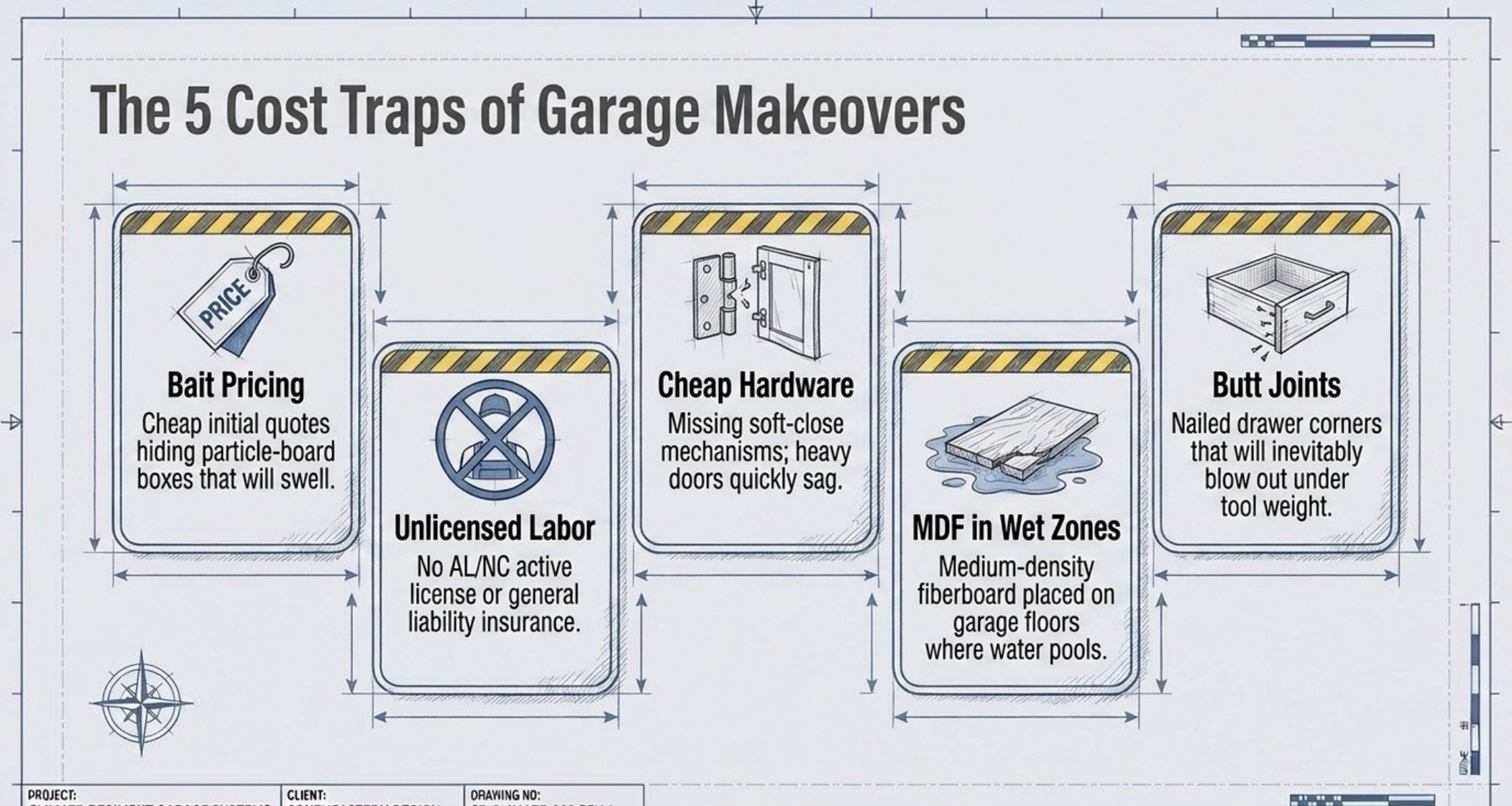
A garage makeover quote is easier to audit than a kitchen quote, because every trap in it produces a signature failure within a few seasons. The five classic traps are bait pricing, cheap hardware, nailed drawer corners, unlicensed labour and MDF used in a wet zone. Each one saves money at the point of order and charges it back later, and each can be detected before deposit by asking a question that starts with the material rather than the price.
| Trap | How it appears in a quote | The signature failure | When it shows |
|---|---|---|---|
| Bait pricing | A cheap initial quote that stops short of naming the box material | Particle-board boxes that swell at the edges and blow out under tool weight | After the first humid season |
| Cheap hardware | Soft-close mentioned but no brand named | Heavy doors sag; mechanisms stop damping within a few years | Years 2–4 |
| Nailed or butted drawers | Solid wood drawers with no joinery detail | Drawer corners fail under the weight of tools | Years 1–3 |
| Unlicensed labour | No licence number, no insurance certificate offered | No recourse if the work fails; liability lands on the homeowner | If something goes wrong |
| MDF in wet zones | Moisture-resistant MDF specified where water pools on the floor | Edge swelling along the toe kick and base | First wet season |
Deck baseline: no active licence and no general liability insurance is a trap, not an oversight — it moves the risk to the homeowner.
Why the garage magnifies each trap
A trap that takes a decade to surface in a kitchen surfaces in a garage in two or three summers. The room is unconditioned, the floor gets wet, tools are heavier than cookware, and the doors are opened and shut with working hands rather than careful ones. That acceleration is useful: the same specification decisions that are debatable in a kitchen are decisive in a garage.
| Garage condition | Why it magnifies the trap | Which trap it hits first | What survives it |
|---|---|---|---|
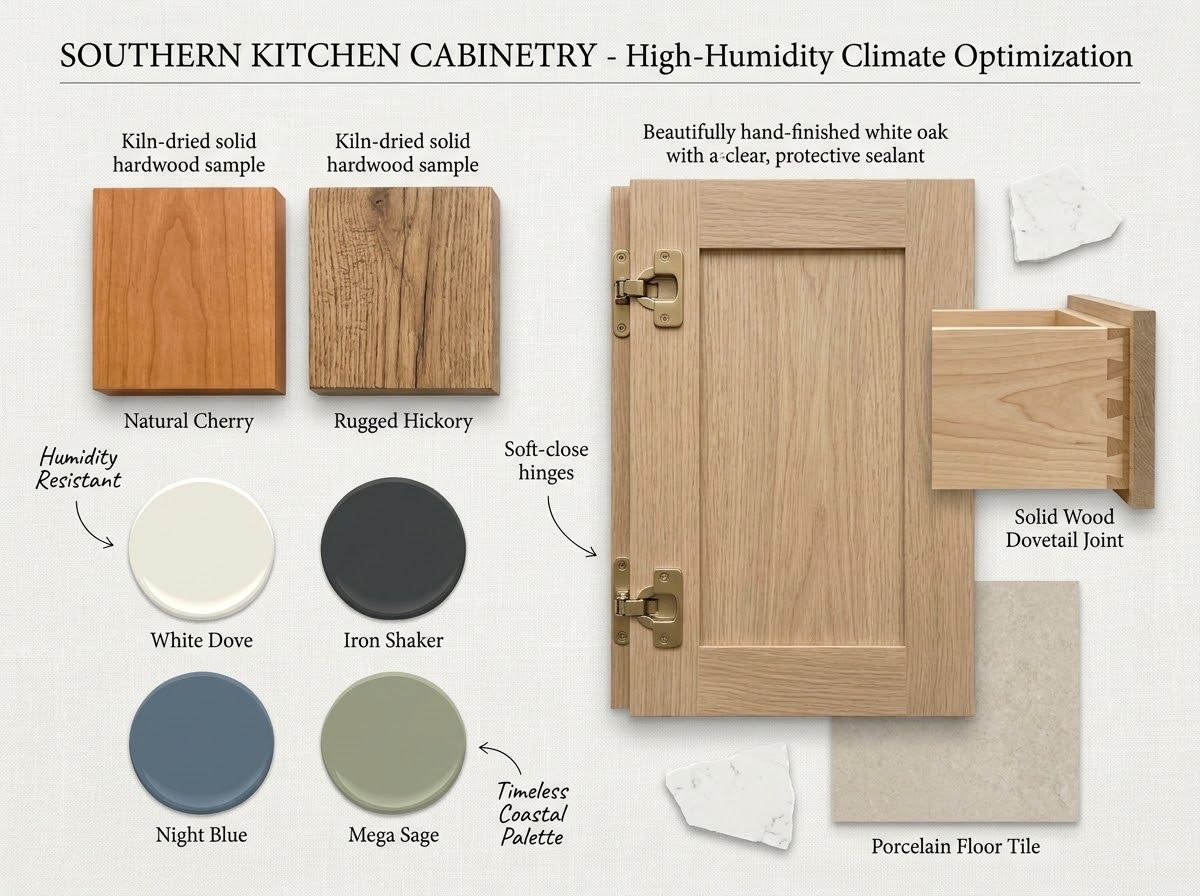
| Unconditioned humidity swing | Composite edges take on moisture with no conditioned air to dry them | Bait pricing and MDF in wet zones | Plywood boxes, kiln-dried hardwood fronts, sealed edges |
| Heavier loads | Automotive tools, fluids and parts exceed a kitchen drawer's normal load | Butt-jointed drawers and cheap shelf construction | Dovetail drawer boxes, reinforced shelving, load-rated glides |
| Floor pooling and splash | Water arrives at the base of the run instead of being mopped up | MDF in wet zones | Units off the floor on legs or a sealed toe kick |
| Impact from equipment | Bikes, mowers and wheeled toolboxes make contact | Thin panels and light hardware | Plywood carcasses and solid hardwood fronts |
| No inspections or permits by default | Nobody is checking the work | Unlicensed labour | A verified licence and insurance certificate before deposit |
The garage is a stress test: it exposes in three years what a kitchen hides for fifteen.
What the right specification costs, and what it saves
Garage cabinetry follows the same installed bands as the rest of the house, so the specification decision has a known price. The difference between the cheap version and the durable version of a garage run is measured in hundreds of dollars at order and thousands across a decade, because the failure mode is replacement rather than repair.
| Component | Cheap version | Durable version | Cost of getting it wrong |
|---|---|---|---|
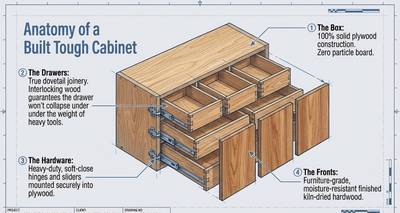
| Box | Particleboard or MDF carcass | All-plywood construction, nothing composite within an inch of the floor | Base-cabinet replacement within a few seasons |
| Drawers | Nailed or stapled corners | True dovetail drawer boxes | Drawer replacement under tool weight |
| Hardware | Unbranded soft-close | Heavy-duty soft-close hinges and glides rated for the load | Sagging doors, non-damping mechanisms, re-adjustment visits |
| Fronts | Painted MDF | Furniture-grade, moisture-resistant finished kiln-dried hardwood | Edge swelling and finish failure across the run |
Each correction costs several multiples of the upgrade it replaced, which is why the arithmetic only resolves one way.
The three questions that disarm all five traps
Before deposit, ask three things and require the answers in writing. What is the box made of, and is any composite used anywhere in the run? What joinery is used on the drawer boxes, and can I see an open drawer? And is the crew licensed and insured, with a certificate naming this address? A supplier working to standard practice answers all three without hesitation; a supplier relying on one of the five traps cannot answer any of them comfortably.
The licensing question in particular is not a formality. Verifying credentials independently takes hours of phone calls and cross-referencing, which is exactly why it is skipped — and exactly why a matching service that runs the check before introduction changes the risk profile of the whole project. In the Montgomery metro the same checks apply as anywhere: a licence status that can be verified, a general liability certificate and workers compensation coverage, all dated to your project.
How to price a garage makeover without walking into the traps
Start by specifying rather than comparing. Write the box material, the drawer joinery, the hardware brand and the treatment of the wet zone onto a single sheet, then ask every shop to price that specification. When the quotes come back on identical scope, the comparison becomes meaningful — and the differences that remain are usually labour quality and finish level, which are the parts worth paying for. A quote that arrives against a different specification is not cheaper, it is a different product.
Then budget the garage like a room rather than an afterthought. Garage cabinetry follows the same installed bands as the rest of the house — roughly $150–$400 per linear foot for stock or RTA, $350–$650 for semi-custom and $500–$1,200 for full custom — and a garage run is often longer than a kitchen run, so the linear footage matters more than the per-foot price. Finally, keep one line in the budget for the envelope: sealing the floor line before the cabinets arrive costs far less than replacing a base unit that stood in a puddle for two summers.
Cost model: the arithmetic of a trap
Every trap saves money at the point of order and charges it back at correction, and corrections are priced at replacement rates rather than repair rates. On a 24-foot garage run, the durable specification sits in the semi-custom band at $350–$650 per linear foot, or $8,400–$15,600 installed. A run built on the trapped components is replaced at the fully custom band, $500–$1,200 per linear foot, or $12,000–$28,800. The penalty for choosing the cheaper build first is therefore $3,600–$13,200, before counting the finish and hardware that come off with the old run.
The linear footage is the multiplier. A two-car garage wall commonly runs 24–30 feet, so the $350 per foot difference between the stock band and the fully custom band is $8,400–$10,500 on wall length alone — which is why a garage quote has to be read as a specification, not a price.
Failure and maintenance truth table
- Box swells at the floor line — bait pricing put particle board where water pools. Base units are replaced, not repaired; inspect the base every spring.
- Heavy doors sag and slam — cheap hardware was specified under a door weight it never carried. Replace the hinge and glide set; check hinges twice a year.
- Drawer corners blow open — butt or nailed corners under tool weight. Dovetail boxes end it; inspect corners after each heavy-use season.
- A defect is refused or ignored — unlicensed, uninsured labour leaves no claim path. A one-time check before deposit; its interval is never “later”.
- MDF edges swell on the floor — a composite in a wet zone. Floor-line units are replaced; the floor line is treated as wet in every inspection above.
Local calibration: Montgomery, Alabama
The traps are the same everywhere, but the garage in this market accelerates all five. An unconditioned slab in Central Alabama sees the summer humidity swing at the floor, where water actually pools, and no heating season dries it out. That is why the licence check is anchored to the Alabama Home Builders Licensure Board, why the wet zone starts at the slab rather than at the sink, and why the same rules apply from the riverfront and downtown districts out to Prattville, Wetumpka, Millbrook and Pike Road.
Decision matrix: choose X if…
| Choose | If the garage… | Because |
|---|---|---|
| Specification-first quoting | is unconditioned, holds water at the floor line, or stores tools | all five traps surface as replacement events, so a written specification is the only line that survives |
| A plywood box with dovetail drawers | runs to the floor or sits beside a wet zone | composites fail at the cut edge, and the floor line is the wettest edge in the room |
| Heavy-duty soft-close hardware | hangs doors wider or taller than a kitchen’s | load per hinge rises and the slam cycle rises with it |
| A licensed, insured installer | on any run touching plumbing or electrical | active licensing and general liability turn a defect into a claim instead of a bill |
| Refacing or specification-grade stock | only when the existing boxes are plywood and still square | otherwise the new fronts are hung on the component that fails first |
Contractor spec-handoff checklist
- Box substrate named: plywood, no particle board, no MDF in the run or at the floor line.
- Drawer joinery named as dovetail; no nail or staple pattern accepted for drawer corners.
- Hardware brand, load rating and full-extension soft-close specification written down.
- Wet-zone treatment stated: sealed base, floor line detailed, edge sealing described.
- Licence number and general liability plus workers compensation certificate, dated to this project.
- Itemised quote separating materials from labour, so scope can be compared like for like.
- Anchoring and blocking method for wall units stated in the scope.
- Confirmed start date and a written punch-list process before deposit.
Sources
- Built Tough: The Ultimate Garage Upgrade (NotebookLM deck) — the five cost traps and the solid-plywood specification standard.
- The Smart Remodeler's Guide to Southern Cabinetry (NotebookLM deck) — Southern humidity baselines and installed cost bands.
- KCMA A161.1-2022 (ANSI/KCMA) — published structural load and impact test protocols.
- Alabama Home Builders Licensure Board — contractor licence verification (confirm current status with the authority having jurisdiction).
Planning a garage makeover in the Montgomery area? Call (334) 500-4632 and we will match you with pre-vetted local cabinet professionals across Montgomery, Prattville, Wetumpka, Millbrook and Pike Road — licensing and insurance verified first. Free, no obligation.
Ready to Talk to a Local Cabinet Pro?
Get free, no-obligation quotes from pre-vetted Montgomery cabinet professionals — licensing, insurance and references checked before you are introduced.
Get Matched in Montgomery →