Verdict: the saving is in the box, and the box is what you live with
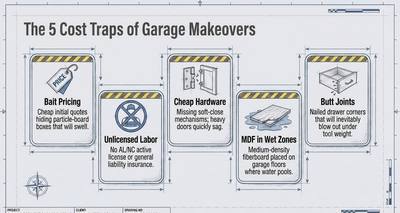
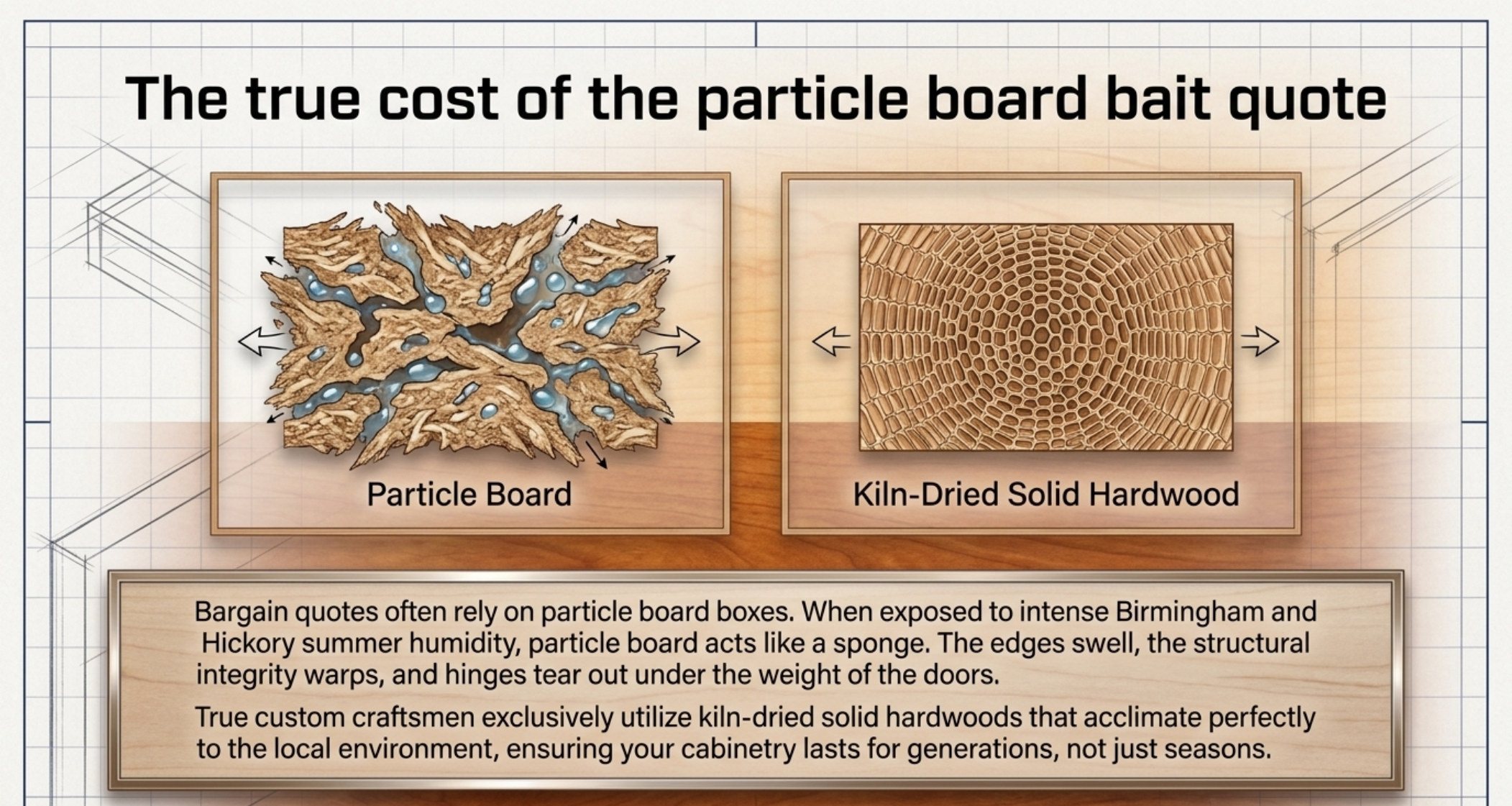
A bait quote is not a low-quality kitchen with cheap doors. It is a normal-looking kitchen built on a box that cannot survive the climate. Particle board exposed to Alabama summer humidity acts like a sponge: moisture reaches the cut edges, the panel swells, the structural integrity warps, and the hinges tear out under the weight of the doors. The homeowner never sees the substitution at the point of purchase, because the doors are hardwood and the finish is the finish they chose. The saving lives entirely inside the carcass. If you have been weighing up custom cabinets quote for a home around Montgomery, AL, this guide covers how it actually works, what it tends to cost, and where the results usually fall short.
| Quote line | What the homeowner hears | What a bait quote actually provides | What a specification-grade quote provides |
|---|---|---|---|
| “Custom cabinets” | Cabinets built for the room | Particle-board boxes, sized to the space | All-plywood boxes, kiln-dried hardwood frames |
| “Solid wood drawers” | Dovetail drawer boxes | Butt joints with glue and staples | Solid-wood dovetail joinery |
| “Soft-close” | Branded soft-close hinges and glides | Unbranded mechanisms with a short warranty | Named-brand full-extension under-mount glides with soft-close |
| “Moisture-resistant” | A panel suited to a wet zone | Standard composite with an unsealed edge | Plywood with sealed edges, no composite in wet zones |
| “Fully installed” | A finished kitchen | A finished kitchen — with a carcass that will swell |
Deck baseline: true custom craftsmen use kiln-dried solid hardwoods that acclimate to the local environment, so the cabinetry lasts for generations rather than seasons.
The failure sequence, stage by stage
Particle-board failure is not random; it follows a sequence that can be predicted from the material. Understanding it is useful because the first two stages are invisible to a casual inspection, and the last two are irreversible.
| Stage | Where it starts | What is happening | Can it be corrected? |
|---|---|---|---|
| 1. Moisture ingress | Cut edges in a sink base, dishwasher bay or garage floor line | The panel absorbs moisture through unsealed edges | Yes — sealing edges prevents it entirely |
| 2. Swelling | Along the same cut edge | The panel expands and loses its dimensions | No — swelling is permanent |
| 3. Finish failure | Where the finish film meets the swollen edge | The film splits along the swelling line | Cosmetic only; it cannot hide the shape change |
| 4. Hinge tear-out | Hinge plates mounted into the swollen panel | Fasteners lose purchase; doors drop and cannot be re-aligned | Only by replacing the box |
By stage three the box is already lost — which is why the specification, not the repair, is the decision point.
What swelling costs in a Montgomery kitchen
The cost of composite failure is not one repair; it is a series of them, spread over years, each small enough to absorb and together larger than the upgrade would have been. That pattern is what makes bait quotes commercially effective, and it is worth pricing honestly before comparing headline numbers. Standard market bands put a full custom kitchen in the Montgomery metro at $10,000–$30,000 and a custom vanity at $2,000–$6,000.
| What fails | Typical correction | Collateral cost | Prevention at order |
|---|---|---|---|
| Sink base swelling | Base cabinet replacement | Countertop reset, plumbing disconnect and re-tie | Plywood base with sealed edges |
| Hinge tear-out on a wall unit | Box replacement or panel repair | Door re-hanging; finish touch-up where fasteners moved | Solid-wood face frame taking the hinge load |
| Drawer corners failing | Drawer box replacement | Possible mismatch with the original front | Dovetail drawer boxes |
| Finish splitting along a swelling line | Refinish or door replacement | Visible mismatch against untouched doors | No composite in wet zones in the first place |
The upgrade is a single line at order; the correction is a rolling series of line items for a decade.
What the correct specification looks like
The counter to a bait quote is not suspicion, it is specification. Four lines cover the box, the joinery, the hardware and the wet zones, and all four can be requested in writing before deposit.
| Requirement | Specification to request | Which rooms it matters most in |
|---|---|---|
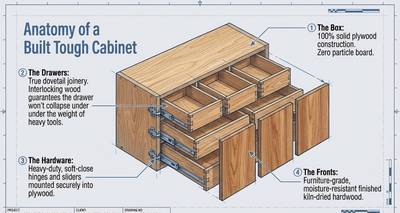
| All-plywood construction | Plywood boxes throughout; particleboard and MDF excluded from wet zones | Kitchens, bathrooms, laundry rooms, garages |
| Kiln-dried hardwood | Species named; moisture content reduced below 10% before fabrication | Every room, in a humid climate |
| Dovetail drawer boxes | Solid-wood dovetail joinery on every drawer, not only the visible ones | Kitchen and utility drawers that carry weight |
| Named hardware | Full-extension under-mount glides with soft-close and a branded hinge | Every drawer and door in the house |
A supplier working to standard practice answers all four immediately — hesitation is the answer.
Reading the next quote you receive
Take the quote and highlight every material claim. If the box substrate is not named, ask. If the drawer joinery is described as “solid wood” rather than dovetail, ask which joint. If the wet zones are not addressed at all, ask what goes under the sink. Three questions will separate the quotes that were built to a specification from the ones that were built to a price, and the difference will be visible in the answer rather than in the headline number. Then ask for the itemised quote separating materials from labour — that document is what makes the specification enforceable.
Why the bait quote is hard to spot on paper
A bait quote rarely says the wrong thing. It says less. “Custom cabinets, fully installed” is a true statement about a particle-board box with hardwood doors, and the price looks credible because the doors — the only component a homeowner inspects — are exactly what was promised. The deception is one of omission, and it works because the box is invisible until it fails. That is why the counter-move is not scepticism but specification: name the substrate, the joinery and the hardware on the quote, and the same shop either meets the specification or explains why it cannot.
There is a second, quieter cost. Particle-board boxes do not fail uniformly, so the correction is piecemeal: one sink base, then a drawer bank, then a wall unit. Each repair is small enough to absorb, and together they cost more than the original upgrade would have. On a Montgomery kitchen in the $10,000–$30,000 band, that is a five-figure lifetime premium paid in instalments for a four-figure saving at purchase.
Cost model: the arithmetic the bait quote hides
A bait quote saves in the box, so the arithmetic is a subtraction you can see. The same 24-linear-foot run prices at $500–$1,200 per linear foot fully custom ($12,000–$28,800) and at $350–$650 per linear foot semi-custom ($8,400–$15,600); the headline saving is $3,600–$13,200. What the quote leaves out is that the correction is priced at the custom band regardless — the run is rebuilt, not repaired — so what was saved at order is repaid in full, before the finish and hardware that come off with the old boxes.
The rolling part is what makes it survivable for the seller: one sink base, then one drawer bank, then a wall unit. Each repair is small enough to absorb, and together they exceed the single upgrade line that would have prevented them.
Failure and maintenance truth table
- Cut edge swells at a wet zone — particle board absorbs moisture at the edge first. Permanent; the base unit is remade and every cut edge on the replacement sealed. Inspect wet zones every spring.
- Hinges tear out under door weight — the fastener purchase is in a swollen composite edge. Replace the box, not the hinge; check hinge tightness twice a year.
- Box warps and the run stops aligning — moisture changed the panel dimensions. Affected units are replaced and neighbours re-fitted.
- Door fronts lift at the edge — a painted composite front swelling in humid months. Irreversible; re-seal every cut edge on replacement.
- Shelf sags under tinned goods — no load rating on the substrate. Replace the shelf; keep heavy goods in lower banks until it is done.
Local calibration: Montgomery, Alabama
The trap works because the substitution is invisible, and Montgomery's climate is what makes the substitution fail. Summer humidity here is enough that an unfinished composite edge moves measurably, and the wet zones — sink base, dishwasher flank, refrigerator surround — see the widest swing in the room. Kiln-dried solid hardwood below 10% moisture content behaves the same across the metro, from the riverfront and downtown districts out to Prattville, Wetumpka, Millbrook and Pike Road. The doors hide the box, so the box has to be named on the quote.
Decision matrix: choose X if…
- Choose a plywood box with dovetail drawers if the kitchen has any wet zone at all, which is every kitchen — treat it as the default, not an upgrade.
- Choose a semi-custom line if the budget sits at $350–$650 per linear foot and the full specification is still written down.
- Choose refacing only if the existing boxes are plywood; otherwise the new fronts go onto the component that fails first.
- Choose to re-scope the quote if the substrate is unnamed — ask for it in writing rather than negotiating a price on a line that was never defined.
Contractor spec-handoff checklist
- Box substrate named in writing: plywood, with no particle board or MDF in the run.
- Cut-edge sealing described for every wet-zone unit, including sink base and dishwasher flank.
- Drawer joinery named as dovetail; “solid wood” is not a joinery specification.
- Hardware brand, load rating and full-extension soft-close specification stated.
- Itemised quote separating materials from labour, so the box line is visible.
- Kiln-dried hardwood below 10% moisture content stated for fronts and boxes.
- Licence and insurance verified with the Alabama Home Builders Licensure Board before deposit.
Sources
- The 8-Week Path to Heirloom Cabinetry (NotebookLM deck) — the particle-board bait quote, the kiln-drying baseline, and refacing economics.
- The Smart Remodeler's Guide to Southern Cabinetry (NotebookLM deck) — Southern humidity baselines and Montgomery Metro cost benchmarks.
- KCMA A161.1-2022 (ANSI/KCMA) — moisture baselining and detergent-resistance protocols for wet-zone units.
- Alabama Home Builders Licensure Board — contractor licence verification (confirm current status with the authority having jurisdiction).
Want an itemised, specification-grade quote for a Montgomery cabinet project? Call (334) 500-4632 and we will match you with local custom cabinet professionals across Montgomery, Prattville, Wetumpka, Millbrook and Pike Road. Free, and no obligation.
Ready to Talk to a Local Cabinet Pro?
Get free, no-obligation quotes from pre-vetted Montgomery cabinet professionals — licensing, insurance and references checked before you are introduced.
Get Matched in Montgomery →