Verdict: four components, and each one is inspectable
Trade-grade cabinetry is not a marketing tier. It is a construction specification made of four components, and every one of them can be verified before or during delivery. The box carries the load and resists moisture. The joints hold the drawers together mechanically. The hardware decides how the kitchen feels several times a day. The certifications prove the material choices were deliberate. In a Montgomery market where a custom kitchen runs $10,000–$30,000, the difference between a trade-grade build and a price-led build sits almost entirely in these four places. If you have been weighing up cabinet making questionnaire for a home around Montgomery, AL, this guide covers how it actually works, what it tends to cost, and where the results usually fall short.
| Component | Trade-grade specification | Why it is the standard | Who notices the difference |
|---|---|---|---|
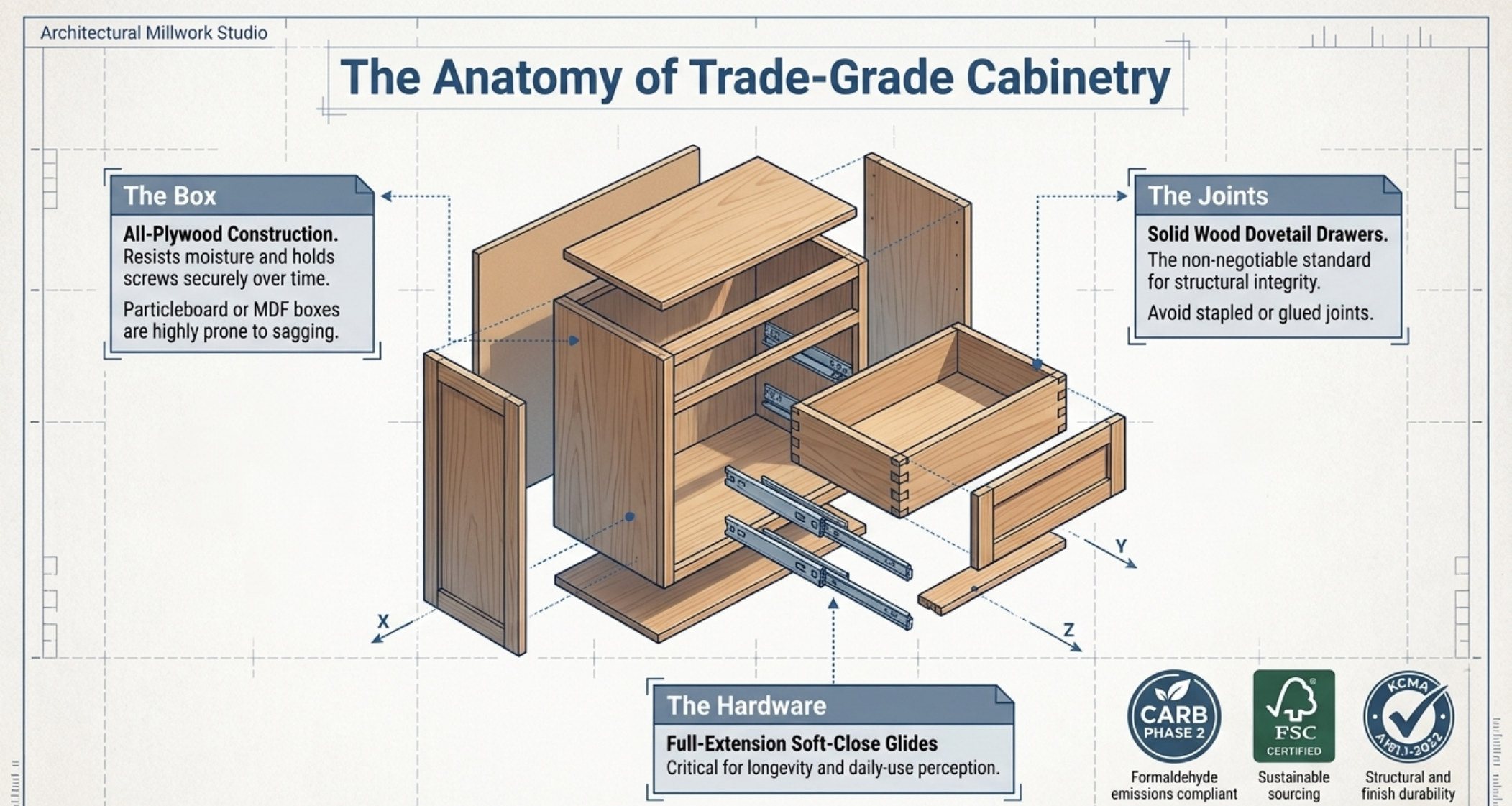
| The box | All-plywood construction | Resists moisture and holds screws securely over time | Anyone whose sink or dishwasher has leaked |
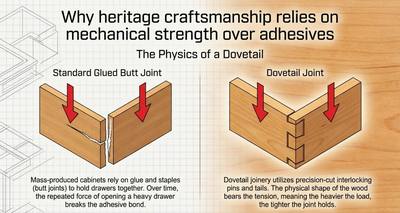
| The joints | Solid-wood dovetail drawers | The non-negotiable standard for structural integrity; avoid stapled or glued joints | Anyone who keeps pans, tools or heavy groceries in a drawer |
| The hardware | Full-extension soft-close glides and hinges | Critical for longevity and daily-use perception | Every person who opens a drawer, several times a day |
| The certifications | CARB Phase 2 compliance; FSC-certified sourcing where specified | Formaldehyde emission control and responsible forestry | The household’s indoor air quality |
Deck baseline: particleboard and MDF boxes are highly prone to sagging — the box is where a price-led quote saves its money.
Why the box is the component worth over-specifying
A cabinet box does three jobs at once: it carries the weight of everything inside, it holds the doors and hardware, and it resists the moisture that a kitchen produces. Plywood does all three well because its layers run in alternating directions, so it holds screws and resists warping. Composite panels do the first two adequately in a dry room and fail at the third, and the failure is permanent — a swollen cut edge does not return to shape when the humidity drops.
| Box upgrade | What it costs relative to a price-led box | What it prevents | Realistic service life |
|---|---|---|---|
| All-plywood construction | Modest per-unit premium | Edge swelling, hinge tear-out and sagging under load | Decades, with touch-up |
| Plywood with a solid-wood hanging rail | Small addition | Wall units carrying load through a thin back panel | Decades; load transfers into the studs |
| Kiln-dried hardwood frames on a plywood box | Larger premium; the regional standard | Humidity-driven movement along the whole door line | Decades, with refinishing |
| Particleboard or MDF boxes | Lowest purchase price | Nothing — it defers the failure and increases its cost | Until the first wet season at a cut edge |
On a humid Alabama budget, the box is the last place to economise and the first place an unfamiliar quote does.
Hardware: the cheapest upgrade with the largest perceived effect
Hardware is the only component a visitor touches. Under-mount full-extension glides support the drawer from underneath rather than from the sides, which raises the weight a drawer can hold and gives full access to the back of the box; integrated soft-close dampening removes the slam that defines a dated kitchen. Both are small line items against the total, and both are routinely left unbranded in a price-led quote.
| Hardware line | Trade-grade specification | Typical price-led substitute | What it feels like in year three |
|---|---|---|---|
| Drawer glides | Under-mount, full-extension, soft-close, branded | Side-mount, partial-extension, no brand | Drawers that stop halfway and rattle on closing |
| Door hinges | Concealed, soft-close, multiple adjustment points | Unbranded hinges with minimal adjustment | Doors that slam and slowly drift out of alignment |
| Shelf supports | Adjustable with reinforced standards | Fixed pins or thin shelf rests | Shelves that sag and cannot be repositioned |
| Screws and fixings | Load-appropriate fixings into solid material | Short screws into panel edges | Hardware loosening and re-tightening cycles |
Brand matters because the warranty follows the brand, and a five-year hardware warranty usually signals a five-year hardware part.
Certifications: the paper trail behind the material choices
Certifications are not decoration; they are the evidence that a supplier's materials were selected deliberately. Two matter most for residential cabinetry, and both are simple to ask for.
| Certification | What it covers | How to ask for it | What its absence implies |
|---|---|---|---|
| CARB Phase 2 | Formaldehyde emissions from composite panels and adhesives | “Is your panel stock CARB Phase 2 compliant?” | Nothing verified about indoor air quality of the panels used |
| FSC certification | Responsibly sourced, well-managed forestry | “Can you supply FSC chain-of-custody documentation?” | Sourcing origin cannot be demonstrated |
| Structural load and finish testing | Shelves, joints and finishes under load, moisture and heat | “Which standard are your shelving and finish tested to?” | Performance claims are not benchmarked |
Ask for these before deposit; a supplier working to standard practice answers immediately.
Reading a Montgomery quote against the four components
Take any local quote and mark it against the four lines. Does the box substrate get named, or is it “quality wood”? Are the drawer corners described as dovetail, or just “solid wood”? Is the hardware branded and specified as full-extension soft-close, or “soft-close included”? And are the panels certified, or unstated? Two unnamed lines out of four is not a bad quote — it is an unfinished one, and the correct response is to ask for the specification rather than to negotiate the price. The market bands for this area — $10,000–$30,000 for a custom kitchen, $2,000–$6,000 for a vanity, refacing near half of replacement — are wide enough that the specification, not the headline number, is what you are actually buying.
Where trade-grade specification shows up after five years
The four components of trade-grade construction fail on different schedules, and that is what makes the specification worth pinning down. Hardware is the first to be noticed, because a glide that stops running smoothly is felt every day. Joints fail next and fail visibly, usually with a drawer corner opening under sustained load. Boxes fail last and fail most expensively, because a swelling panel takes the doors and hardware with it and can only be corrected by replacement. Certifications never fail at all — they are the evidence that the material choices were deliberate rather than incidental.
That ordering is also the order in which a homeowner should spend discretionary budget. On a Montgomery kitchen in the $10,000–$30,000 band, moving money from an exotic finish into dovetail drawer boxes and full-extension soft-close glides is a small reallocation with an outsized effect on how the kitchen feels in year five. The finish is what a visitor notices once. The boxes and hardware are what the household uses several hundred times a day.
Cost model: a reallocation, not an addition
Trade-grade specification is a reallocation rather than an extra line. On a Montgomery kitchen in the $10,000–$30,000 band, the box and joinery decision is priced by the installed band — $350–$650 per linear foot semi-custom against $500–$1,200 fully custom — and hardware is a small line against the total. Moving money from an exotic finish into dovetail drawer boxes and full-extension soft-close glides changes a few percent of the project and a large fraction of daily use.
Origin runs the other way. A $3,000 wholesale package becomes $3,000 × 1.25 = $3,750 at the 25% Section 232 base tariff and up to $3,000 × 1.40 = $4,200 at combined rates near 40%, so sourcing is a cost decision as much as a quality one.
Failure and maintenance truth table
- Glide stops running smoothly — the first component noticed, because it is felt every day. Replace the glide set; check hardware annually.
- Drawer corner opens under load — next to fail, and it fails visibly. Replace the drawer box; inspect corners after heavy-use seasons.
- Box swells at a wet zone — last to fail and most expensive, because it takes the doors and hardware with it; replacement only, so inspect wet zones every spring.
- Panel edge lifts on a painted front — finish breakdown at the cut edge. Re-seal and touch up; replace if delaminated.
- Certification is unverifiable — never fails physically, but removes your evidence when something else does. Confirm at order, once.
Local calibration: Montgomery, Alabama
The component ordering is what a Montgomery budget should follow, because the climate sets the failure schedule. Hardware is the earliest and cheapest to correct, joints next, boxes last and most expensively — and in a humid market the box cannot be restored once it has swollen. That ordering holds across the metro, from the riverfront and downtown districts out to Prattville, Wetumpka, Millbrook and Pike Road, which is why the four specification lines belong on the quote rather than in a brochure.
Decision matrix: choose X if…
- Choose to over-specify the box first if the budget forces a sequence — plywood and sealed edges are the component that fails last and costs most to correct.
- Choose dovetail drawer boxes if drawers carry anything heavier than linen, which in a kitchen means all of them.
- Choose branded full-extension soft-close hardware if the household opens drawers more than a few times a day, because the warranty follows the brand.
- Choose domestic or regional sourcing if price stability matters across the project window, given the 25%–46% import exposure on the same components.
Contractor spec-handoff checklist
- Box substrate named: plywood, with panel thickness stated for sides and back.
- Drawer joinery named as dovetail for every drawer bank.
- Hardware branded and specified as full-extension, with load rating and soft-close stated.
- Mounting substrate named for every hinge and glide.
- Certifications listed individually: CARB Phase 2, FSC where claimed, and finish-durability compliance.
- Manufacturing origin named, so tariff exposure and parts availability are visible.
- Itemised quote separating materials from labour, with the four components on separate lines.
Sources
- 2026 Cabinet Market Intelligence & Strategic Sourcing Guide (NotebookLM deck) — the four components of trade-grade cabinetry, origin-versus-risk matrix, and Section 232 tariff arithmetic.
- KCMA A161.1-2022 (ANSI/KCMA) — published structural and finish durability test protocols.
- The Smart Remodeler's Guide to Southern Cabinetry (NotebookLM deck) — certification requirements (CARB Phase 2, KCMA) and Montgomery Metro cost benchmarks.
- Alabama Home Builders Licensure Board — contractor licence verification (confirm current status with the authority having jurisdiction).
Want cabinetry built to a written four-component specification in the Montgomery area? Call (334) 500-4632 and we will match you with local cabinet professionals across Montgomery, Prattville, Wetumpka, Millbrook and Pike Road. Free, and no obligation.
Ready to Talk to a Local Cabinet Pro?
Get free, no-obligation quotes from pre-vetted Montgomery cabinet professionals — licensing, insurance and references checked before you are introduced.
Get Matched in Montgomery →