Verdict: one joint gets stronger as you load it, the other gets weaker
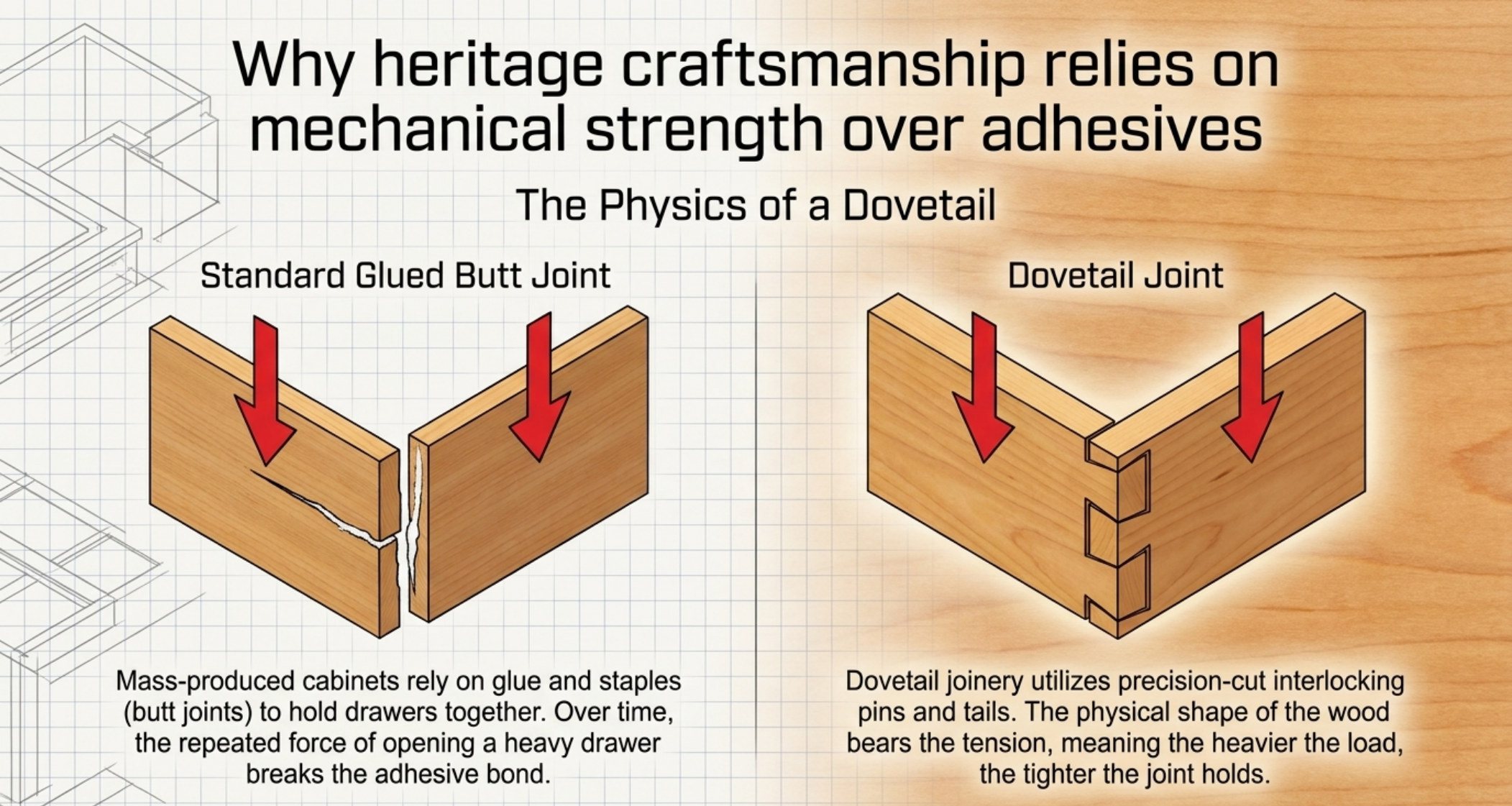
A drawer carries load, and how it carries it is a materials question rather than a craft preference. A glued butt joint holds its sides together with adhesive, which is a chemical bond that does not improve with use. A dovetail joint uses precision-cut interlocking pins and tails, so the physical shape of the wood bears the tension: the heavier the load, the tighter the joint holds. Everything else about drawer construction — the thickness, the finish, the glide rating — sits on top of that single difference. If you are here looking into kitchen cabinet installation, the sections below walk through the process from the first quote to the finished job.
| Joint type | What carries the load | Behaviour as load increases | How it fails |
|---|---|---|---|
| Dovetail | Interlocking pins and tails; the wood resists the pull | The joint tightens | Rarely; failures are usually in the glide or the drawer bottom |
| Glued butt joint | The adhesive bond alone | The bond is progressively stressed | The adhesive breaks at the corner; the drawer splays |
| Stapled butt joint | Staples plus glue | The staples loosen in the surrounding material | Corners open, then separate under sustained weight |
| Dadoed or rabbeted joint with mechanical fixing | A rebate plus fasteners | Better than a butt joint; still concentrated at the fixing | Fasteners wallow out with repeated cycling |
Deck baseline: cheap glued butt joints fail rapidly at the drawer corners under the heavy weight of pots and pans.
What a drawer actually experiences
Drawers fail faster than any other part of a kitchen because they combine sustained load with repeated motion. The pull-out motion converts the load into a repeated stress cycle at the corners, and a kitchen produces thousands of those cycles a year. The published standard for the mechanism is a cycle test under load, and the shelf standard behind it is a uniform load held for days — a combination that describes exactly what a loaded drawer does without rest.
| Stress on a drawer | Magnitude | Effect on a dovetail box | Effect on a stapled box |
|---|---|---|---|
| Sustained load while stored | Heavy cookware, tools or groceries | Transferred into the interlocking joint | Carried by adhesive and staples |
| Repeated open-and-close cycles | Thousands per year in a busy kitchen | Mechanically stable; wear shows in the glide | Corners accumulate micro-damage |
| Dynamic load on a running drawer | The drawer's contents in motion | Joint geometry resists splay | Corner seams open progressively |
| Moisture from a dishwasher nearby | Recurring ambient humidity | Solid wood moves slightly and returns | Composite or poorly fastened joints loosen |
Count the cycles rather than the years — a drawer used ten times a day crosses 3,600 cycles a year.
The failure timeline, and what it costs
Corner failures are rarely sudden. They announce themselves with a slight flex, then a visible seam, then a drawer that no longer runs true because its geometry has changed. By the time the corner opens, the drawer box is a replacement item, and in a matched kitchen the replacement must match a front that may no longer be in production.
| Stage | What you notice | What is happening | Cost to correct |
|---|---|---|---|
| Early | A faint creak or flex on a loaded drawer | Adhesive bond beginning to work | Nothing yet — the warning stage |
| Middle | A visible seam at the drawer front | The corner is opening | Drawer box replacement |
| Late | The drawer runs unevenly and jams | Racked geometry; glides out of alignment | Drawer box replacement plus glide adjustment |
| Failure | The corner separates under load | Structural failure | Replacement, and damage to the contents and finish |
A dovetail drawer that is loaded heavily is not stressed more than a glued one — it is held more firmly.
Specifying and verifying dovetail drawers
Dovetail joinery is a specification line, not a price tier, and it belongs in writing on the quote for every drawer in the kitchen — not only the visible ones. The verification is visual and takes seconds per drawer, which makes it one of the easiest quality claims in the trade to check.
| Where to look | Dovetail | Butt or stapled joint | Why the difference matters there |
|---|---|---|---|
| Drawer corners | Interlocking pins and tails; no structural fastener visible | Straight seam with staples or screw heads | The corner carries the entire drawer load |
| Under heavy pot drawers | Joint tightens under load | Bond takes the whole load | The heaviest drawers are the ones that fail first |
| Drawer bottoms | Rebated or captured into the sides | Stapled or loosely set | The bottom carries the contents, not the sides |
| Under-mount glides | Rated for the drawer's loaded weight, full-extension | Partial-extension or unbranded | The mechanism is only as good as the box it is fixed to |
Good joinery on the visible drawer and staples on the hidden ones is the classic retail split — inspect every drawer, not the showroom sample.
What this means for the Montgomery kitchen budget
Dovetail drawer boxes sit inside the normal custom band for this market — a full custom kitchen runs $10,000–$30,000, a vanity $2,000–$6,000, and refacing lands near half the replacement figure at $5,000–$15,000 while keeping whatever drawer boxes already exist. That last point is worth checking before choosing refacing: re-skinning a kitchen whose drawer boxes are stapled means paying to keep the component most likely to fail.
How to inspect a drawer joint in ten seconds
Pull the drawer fully out and look at the corner where the side meets the front. A dovetail shows interlocking pins and tails with a visible zig-zag pattern and no visible fasteners doing the structural work. A butt joint shows a straight seam, usually with staples or visible screw heads, and often with a smear of dried glue. On a painted or laminated drawer the joint may be hidden, which is why the inspection belongs before deposit: ask to see an open drawer in the shop, not a closed one in a showroom.
The second inspection is the load test a household runs automatically: take the drawer out, put the heaviest thing that will live in it back in, and watch the corner as you push the drawer in and out. A dovetail box does not change shape. A stapled box flexes — slightly at first, and permanently after a few hundred cycles. That flex is the early warning of the corner failure that follows.
Cost model: the arithmetic behind the joint
Dovetail joinery is a specification line, not a price tier, so the arithmetic starts from the installed bands. A 28-linear-foot kitchen prices at $500–$1,200 per linear foot fully custom ($14,000–$33,600) and at $350–$650 per linear foot semi-custom ($9,800–$18,200 for the same 28 feet). The $4,200–$15,400 spread is not finish; it is box, joinery and hardware. Refacing keeps whatever drawer boxes exist and lands near half of replacement at $5,000–$15,000.
Load is the other half. A drawer used ten times a day crosses 3,600 cycles a year, so a ten-drawer kitchen runs 36,000 cycles annually — 180,000 across five years, all concentrating at four corners per drawer. That concentration, not the door front, is why the box fails first in a humid climate.
Failure and maintenance truth table
Read the corners as a truth table: the symptom sets the stage, and the stage decides whether maintenance is possible or the box is lost.
- Faint creak on a loaded drawer — the adhesive bond is beginning to work. No repair yet; log it and re-check monthly.
- Visible seam at the drawer front — the corner is opening under load. The box is a replacement item, and no maintenance restores a broken bond.
- Drawer runs unevenly or jams — geometry has racked and the glides are no longer parallel. Replace the box, re-align the glides, then an annual check.
- Doors sag at the box — the fastener lost purchase in a swollen panel edge. Replace the box, not the hinge; quarterly check through the humid months.
Local calibration: Montgomery, Alabama
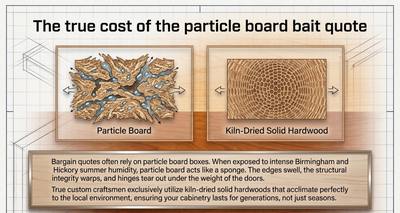
Montgomery's summer humidity turns this from a preference into a threshold. Panels across the metro swing far enough that an unfinished cut edge moves measurably, and the swing is widest at the wet zones — sink base, dishwasher flank and refrigerator surround. The same holds from the riverfront and downtown districts out to Prattville, Wetumpka, Millbrook and Pike Road. Kiln-drying below 10% moisture content is what makes a drawer box indifferent to that swing.
Decision matrix: choose X if…
- Choose full-custom boxes with dovetail drawers if the layout is wrong or the boxes are failing — $500–$1,200 per linear foot buys a carcass still square in twenty years.
- Choose a semi-custom line with dovetail drawers if the layout works and the budget sits at $350–$650 per linear foot.
- Choose refacing only if the boxes are plywood and the corners already dovetailed; re-skinning a stapled box fronts the component that fails first.
- Choose a stapled-joint box only for a utility drawer that never carries load, and price the replacement in.
Contractor spec-handoff checklist
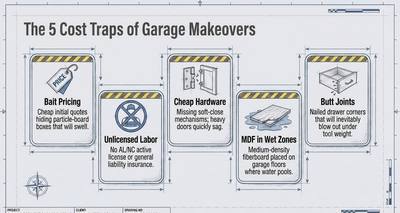
- Box substrate named: plywood, with no particle board or MDF in the run.
- Drawer joinery named as dovetail for every drawer, not only the visible ones.
- Kiln-dried hardwood stated, moisture content below 10%.
- Glide and hinge brand, extension and soft-close rating on the quote.
- Wet-zone boxes (sink, dishwasher, refrigerator) confirmed as plywood in writing.
- Licence and insurance verified with the Alabama Home Builders Licensure Board before deposit.
Sources
- KCMA A161.1-2022 (ANSI/KCMA) — published cabinet test protocols for structural load, impact and detergent resistance.
- The 8-Week Path to Heirloom Cabinetry (NotebookLM deck) — dovetail versus butt-joint mechanics, the kiln-drying standard, and the 3,600-cycle drawer baseline.
- The Smart Remodeler's Guide to Southern Cabinetry (NotebookLM deck) — Central Alabama climate baseline and Montgomery Metro cost benchmarks.
- Alabama Home Builders Licensure Board — contractor licence verification (confirm current status with the authority having jurisdiction).
Want dovetail drawer construction specified in writing for a Montgomery kitchen? Call (334) 500-4632 and we will match you with local cabinet professionals across Montgomery, Prattville, Wetumpka, Millbrook and Pike Road. Free, no obligation.
Ready to Talk to a Local Cabinet Pro?
Get free, no-obligation quotes from pre-vetted Montgomery cabinet professionals — licensing, insurance and references checked before you are introduced.
Get Matched in Montgomery →